Program Details
Friday, April 12, 2024
—
Curated by Jaclyn Quaresma
—
Work by Felippe Mussel, Diana Vidrascu, Nour Ouayda
—
Images Festival, Toronto
Co-Presented with Planet in Focus International Environmental Film Festival and Charles Street Video
—
A conversation between Jaclyn Quaresma and filmmakers Felippe Mussel and Nour Ouayda
This film program considers the more-than-human rhythms that sustain all life on this planet, including our own. At times ominous, and others humorous, spiritual, and tender, the videos in Measured by Some in Seasons invite the audience to become tangled in nature’s timeline, placing oneself and their community within a greater shared web of ecosystems that are our vital, relational partners.
Espectro Restauración (Spectrum Restoration) is a spectrogram created by filmmaker and sound designer Felippe Mussel. In this work, he invokes Article 72 of the Ecuadorian Constitution—Nature has the right to restoration—in defense of the Pantanal. The Pantanal is the world’s largest tropical wetland area, and the world’s largest flooded grasslands. Its flood cycle, colloquially known as the flood pulse, is essential to all life in the region. It has recently been altered by the fires spurred by agribusiness in the highlands and by climate change. As we see and hear the sounds captured by the spectrogram, one is reminded that the Pantanal has diminished by over 20% as a result of these environmental pressures. Restoring the region, and its flood pulse, may take decades, if not centuries of concerted effort. A process made even more challenging given that this right to restoration is not afforded by the constitutions of the nations that claim the Pantanal: Brazil, Bolivia, and Paraguay.
Using Kodak Aerochrome infrared-capturing film, a matte technique, and an Oxberry optical printer, Diana Vidrascu formally meditates on the overlay of spiritual, cultural, and scientific knowledge that underpins Azorean culture. Centring Portugal’s volcanic islands in the mid-Atlantic, The Azores, Vulcão: O Que Sonha um Lago? (Volcano: What Does a Lake Dream?) mimics and reinforces the seismic rhythms that create, alter, and eliminate life and land in the area, while also calling into question ideas of land ownership and the plausibility of the nation-state.
Measured by Some in Seasons borrows its name from a line in the final film in this program: Nour Ouayda’s The Secret Garden. Throughout eight acts captured on analogue film, then digitized, two friends investigate the sudden population of their unnamed city by strange lifeforms. Guided by an ancient text, Camelia and Nahla attempt to find the origins of these beings, recounting their findings and cataloging their subjects. Time begins to shift: the deeper Camelia and Nahla fall into their investigation, the more estranged they become from themselves, leaving the audience to wonder: who is really in control?
Program Schedule

Espectro Restauración, Felippe Mussel, 2022 | Brazil | HD | 8 minutes | Spanish with English translation.
The sound spectrogram of a fire in the Pantanal forest, a biome constantly suffering from its exploitation by agribusiness in South America. To fight the fire, the film evokes the phrase “La naturaleza tiene derecho a la restauración,” an excerpt from the Ecuadorian Constitution that, based on indigenous precepts, gave Nature (“Pacha Mama”) a legal status with equal rights to those of human beings.

Vulcão: O Que Sonha um Lago? (Volcano: What Does a Lake Dream?), Diana Vidrascu, 2019 | France, Romania | 16 MM | 21 minutes| Portuguese with English subtitles.
A volcano draws its visual energy from the tectonic plates clashing under the Azores islands. From the depths of the boiling earth to the surface of the celluloid film, an experimental documentary erupts.
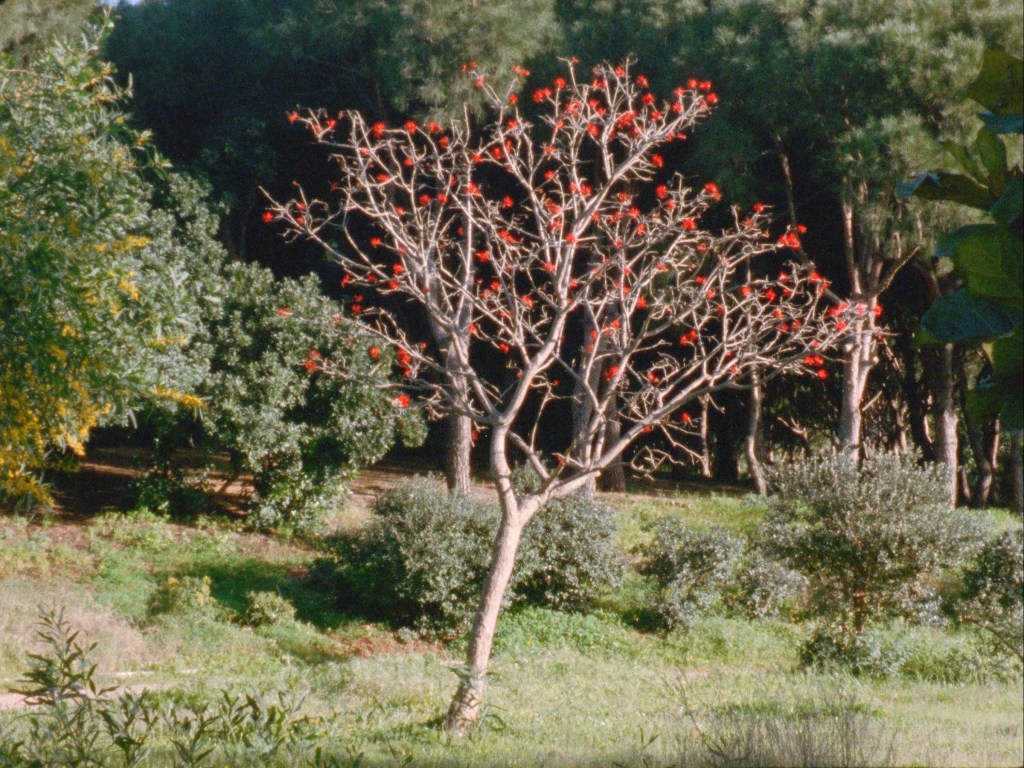
The Secret Garden, Nour Ouayda, 2023 | Lebanon | Super 8 , 16mm > Digital| 27 minutes | Arabic with English subtitles.
The inhabitants of a city wake one morning to find never-before-seen trees, plants, and flowers have suddenly erupted throughout the streets and in the squares. Strange and mysterious events start taking place as Camelia and Nahla investigate the origins of these new and peculiar creatures.
Felippe Mussel is a sound designer and filmmaker based in Rio de Janeiro. He has been responsible for the sound of over 40 Brazilian movies. In 2012, he directed the feature documentary A Place to Take Away. He is also a PhD candidate in Contemporary Art Studies at Universidade Federal Fluminense.
Diana Vidrascu (Romania) is a filmmaker based in Paris, France. Working with film, photography, and installation, Diana Vidrascu questions the narrative devices of cinema by challenging the limits of the narrative discourse and codes of the film genres. She debuted as a director in 2017 and her films have screened in international festivals such as: Locarno Film Festival, Berlinale Forum Expanded, IFFR International Film Festival Rotterdam, BFI London Film Festival, Experimenta, and the Chicago International Film Festival.
Nour Ouayda is a filmmaker and film programmer. Her films experiment with various forms of fiction writing in cinema. She is a member of The Camelia Committee with Carine Doumit and Mira Adoumier and part of the editorial committee of the Montreal-based online film journal Hors Champ.
 Jaclyn Quaresma