September 13, 2019 – December 9, 2019
—
Curated by Jaclyn Quaresma
—
Work by Véronique Sunatori
—
Durham Art Gallery, West Grey, Canada
—
This exhibition is presented as a part of the Words Aloud Word and Storytelling Festival and was host to multiple readings. It is accompanied by an .epub catalogue that includes exhibition documentation.
A single artwork and an accompanying reading room together compose the exhibition, A Little Larger Than The Entire Universe. The exhibition speculates the possibility of empowered and emboldened futures. Imagining what may come in the future, artwork and text, as well as poetry and spoken word performances, come together to reconstruct the present.
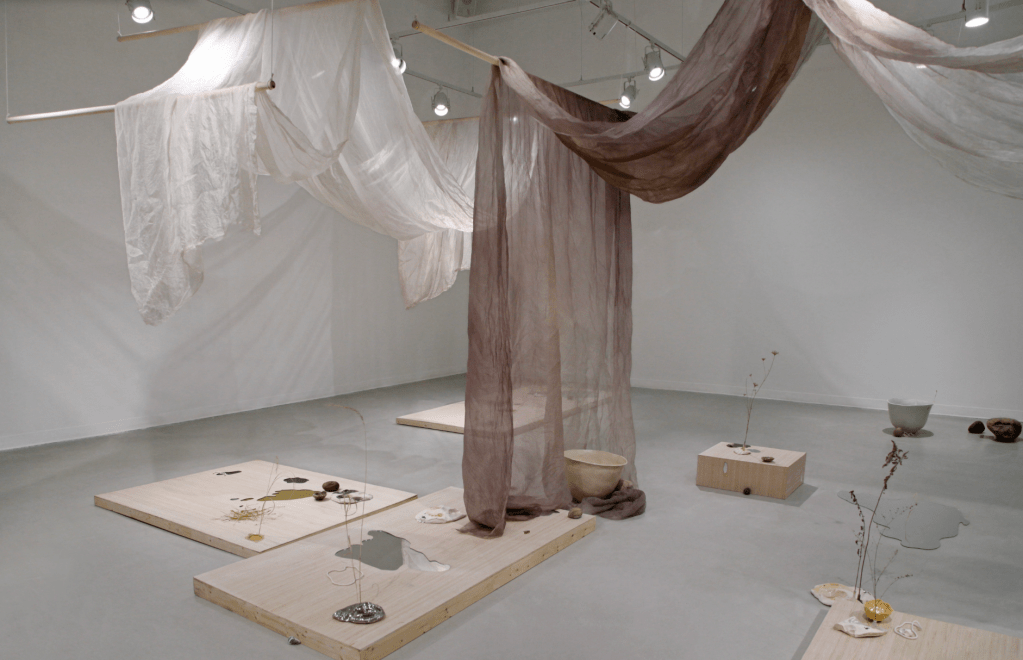
The artwork, It Will Come Like a Wave by Japanese – Québécois artist Véronique Sunatori, consists of multiple wooden platforms that when placed together, create a landscape. A large swath of naturally dyed silk organza hangs over the installation like a fallen sky (Or, could it be a plume of smoke? A boggy wave?). A full, golden moon is tethered to the ceiling, it reflects not light from the sun, but the viewers own image back to them. Ceramics sit atop the clean rectangular platforms alongside replanted grasses. Moonlit footprints are squished permanently into blobs and bits. Mirrors shaped into puddles spot the grounds. Are they ponds? Deep pools of metaphorical reflection? Mercurial stains? Brass-coloured toxic waste left behind by a retreating wave? Or, perhaps they are portals that lead to far off lands. Are they earthbound?
It Will Come Like a Wave (2018) is as much as an inward landscape as it is an otherworldly garden. Véronique, who is currently living in Toronto, Ontario, was inspired by the Zen gardens of Japan. Like traditional Zen gardens, this one has elements of water, stone and plant-life. These elements combine to create the essence or feeling of nature, but not to recreate nature itself.
Small forms with a faux, stone surface mimic the shape of the puddles. Water in shape and rock in texture, these objects are neither. Placed alongside or on top of them are pairs and clusters of found stones confirming that these imposters are not what they appear to be. Likewise, the mirrored puddles that lend their shape to the stone-ish forms are denied their watery-ness when compared to the pools of clear resin that dot the platform grounds. Though liquid in appearance they too deny us the splash, the soothing coolness and wet that comes with water. Each time Véronique offers the viewer something recognizable, she places another object a little more real or a little less fake nearby. This is a landscape that has been designed to provoke meditation and deep reflection.
Throughout the installation, one comes upon partial footprints squished into clay. The footprints differ from one another: spotted here, white gold there, another with pink, the one next to it dusted with a clear glaze. These prints are not quite like our own. Unlike a muddy print that washes away, these are permanent. Might they signal to our own “carbon footprints,” having an everlasting impact on the environment?
Véronique brings It Will Come Like a Wave to Durham after being exhibited in Montreal, Mississauga and Toronto. Each version of the installation varies from the previous: the arrangements are altered to suit their current location. In this way, the unfolding landscape is the same and utterly different for each iteration. Walking in the garden causes one to slow their pace, to acknowledge the vulnerability of the fabricated environment in the Gallery, of our greater environment, of oneself, and of each other.
This vulnerability is heightened, magnified, and reflected to us here in Durham, West Grey. The municipality of West Grey declared a climate crisis over the summer joining Grey Highlands in the communities of Grey County that are signalling significant changes to their environments. In the neighbouring Wellington County, the Township of Guelph/Eramosa has also declared an ecological emergency. How long until the previous cities that have hosted this artwork declare a crisis as well?
Alongside It Will Come Like a Wave is a collection of science fiction compiled in an intergalactic, intersectional, trans-inclusive, feminist reading room. As Margaret Atwood writes in the introduction to In Other Worlds: SF and the Human Imagination, this exhibition “is not a treatise, it is not definitive, it is not exhaustive, it is not canonical. It is not the work of a practising academic or an official guardian of knowledge, rather it is an exploration…” [1] A Little Larger Than The Entire Universe: An Intergalactic Reading Room offers multiple imaginaries that speculate the possibility of manifold futures. These stories make space for open, lively worlds beyond the one we inhabit and help us to reflect upon our own.
Whether they speculate utopian agendas or dystopian futures, technological advancements that save or destroy humanity as a whole or in part, or whether aliens, distinct planets, and the relations therein are supported or torn apart, this reading room presents futures, pasts and alternate presents that are tethered to our current condition. Can science fiction read through a feminist lens help us to conceive of the possible futures that may result from crisis?
The title of the exhibition, A Little Larger Than The Entire Universe, is reclaimed from an untitled poem written by Portuguese poet Alvaro de Campos in 1934. De Campos was famous for his poems written in the literary style of Futurism. This genre of writing and art-making is known to be particularly misogynist, the manifesto itself declared an open distain for women. The future depicted by the Futurist Movement had no place for emboldened anti-racism or empowered gender fluidity and equality.
The genre of science fiction is similarly plagued by racism and misogyny. As author N.K Jemisin says in her acceptance speech at the 2018 Hugo Awards “…SFF [Science Fiction and Fantasy] is a microcosm of the wider world, in no way rarefied from the world’s “pettiness or prejudice.” [2] The Hugo Awards are considered North North America’s most prestigious science fiction and fantasy awards. They are voted on by members of the World Science Fiction Convention (Worldcon), which is also responsible for giving the prizes. She was, in part, responding to instances such as bloc voting campaigns led by groups like Sad Puppies and Rabid Puppies. In 2015 they systematically voted against women and people of colour in order to “reclaim” the awards. Nevertheless, authors that identify as BIPOC3 and across the spectrums of gender and sexuality continue to explore the crisis points of contemporary society through the genre.
It Will Come Like a Wave volunteers the serenity that is sometimes necessary for contemplation. Its altered geography positions the viewer in a potential future or an altered present while the reading room provides texts that reconstruct the present, imagining what may come from environmental, social and political change hereafter. In response to this pairing, artist Véronique has made sculptural objects to support the books. Clay, resin and dried chrysanthemums simultaneously cradle the stories and gently offer them to the viewer-cum-reader, asking them to move from quiet contemplation to generative imagining.
A Little Larger Than The Entire Universe: An Intergalactic Reading Room is presented as a part of the Words Aloud Word and Storytelling Festival. The festival is organized around the theme of inspiring conversations about where society is and where it’s headed. The environmental, social and political reflection prompted by the installation is echoed in the page poetry, slam poetry and spoken word performances that take place in the gallery, throughout the festival, and during writing workshops.
This year’s lineup includes three-time world champion spoken word artist Buddy Wakefield, the multi-talented Charlie Petch, celebrated poet and essayist Lorri Neilsen Glenn, as well as Alicia Elliott, Greg Santos, Prufrock Shadowrunner, Ruth Daniell, yes – the poet, and special guest Sabrina Benaim among others.
[1] “Margaret Atwood, In Other Worlds: SF and the Human Imagination (Toronto: Signal McClelland & Stewart, 2012) i.”
[2] Joel Cunningham, “The Stars Are Ours: Read N.K. Jemisin’s Historic Hugo Speech,” The B&N Sci-Fi and Fantasy Blog, Barnes and Noble. 20 August 2018. https://www.barnesandnoble.com/blog/sci-fi-fantasy/read-n-k-jemisins-historic-hugo-speech/.
About the Artist
Véronique Sunatori was born in 1991, Gatineau, Canada. She lives and works in Toronto, Canada.
 Jaclyn Quaresma
Leave a comment